— THE NORTH STAR · ~1140 BC
Unreal Engine 5 · Eight civilizations · One Mediterranean · Years away
"
A world before history wrote itself down. The gods watched. The sea listened. The work was the prayer.
— Bronze Age · A multiplayer set on the eve of the collapse
I.
— THE WORLDO Mundo · Geografia & Clima
— GEOGRAPHY · CLIMATE

A sea that remembered everyone.

Nine maps. Eight civilizations on dry land. One Mediterranean that connects them all — and one season, drawing close, that will set the world on fire.

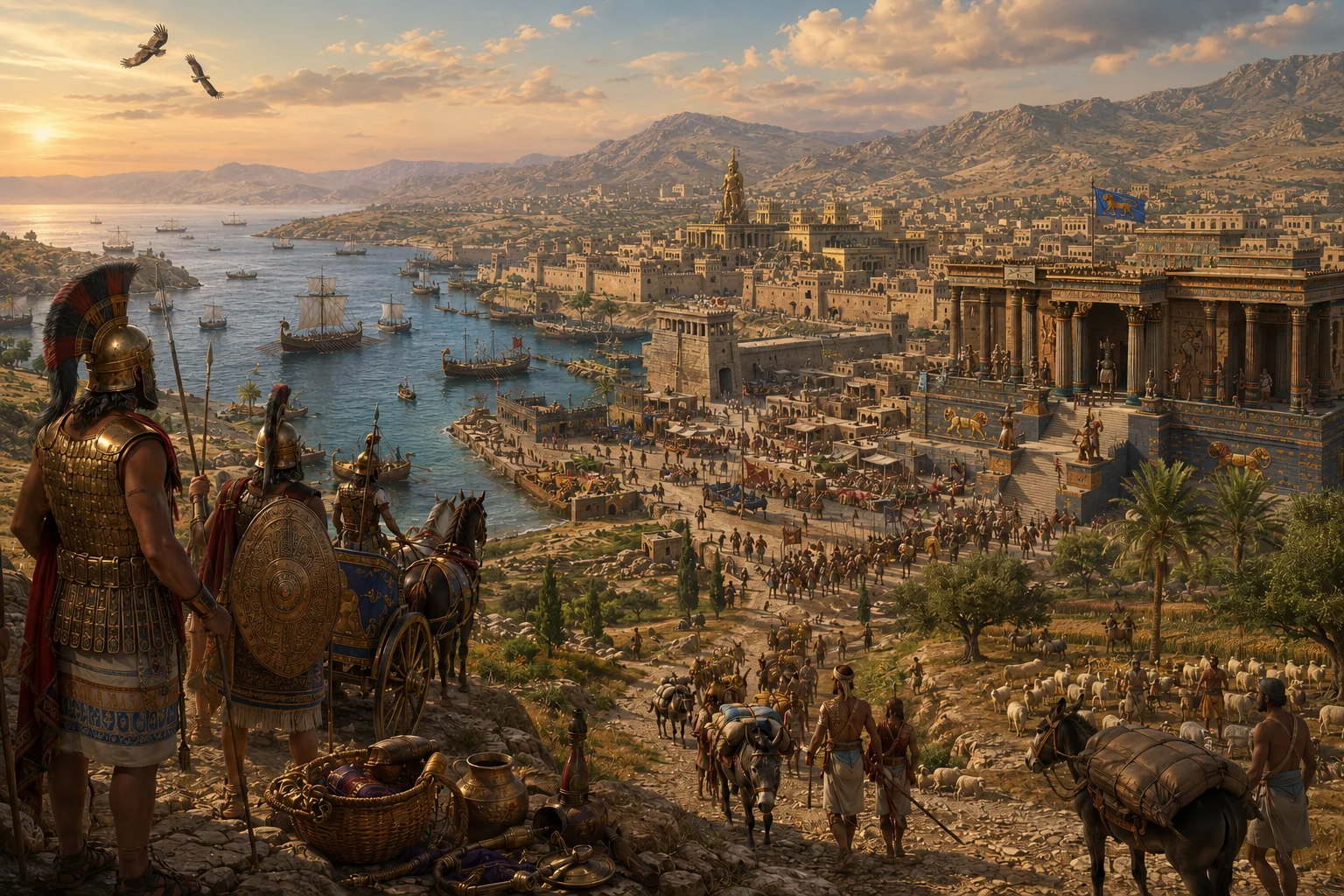
The Mediterranean of the late Bronze Age was not a wall between peoples — it was a corridor. Phoenician timber sailed to Egyptian ports. Cypriot copper crossed to Mycenaean smithies. Anatolian tin moved south through hands that never met. Trade was survival. Trade was language.

The seasons of the game are real. Years pass. Harvests come in their time and so do the storms. A simulated climatic drought is being prepared inside the world — long, slow, exact — that begins to bite around 1147 BC. The settlements that fail to read the wind early enough do not get a second chance.

O Mediterrâneo não era um muro — era um corredor. Madeira fenícia ia para os portos egípcios. Cobre cipriota cruzava até as forjas micênicas. Estanho da Anatólia descia por mãos que nunca se encontravam. O comércio era sobrevivência. Era linguagem. E uma seca simulada se prepara dentro do mundo, lenta e exata, para morder por volta de 1147 a.C. — só quem ler o vento a tempo terá uma segunda chance.

II.
— THE EIGHTAs Oito · Civilizações
— THE CIVILIZATIONS

Eight peoples. No meta, no winner.

Each civilization is a map. Each has a strength the others do not. None is the "correct" choice — only the one that fits the player you already are.

The roster will settle through play-testing, but the foundation is the world of the late second millennium BC. Among the candidates: Egypt with its river and its grain; Mycenae, the warlords of the Aegean; the Hittites, masters of the Anatolian plateau; the Phoenicians, who taught the sea to write; and others whose names history almost lost.

Egypt
River-fed grain · stone & gold
Mycenae
Warlords of the Aegean · cyclopean stone
The Hittites
Anatolian plateau · iron-curious
Phoenicians
Cedars & the sea · the first alphabet
Minoan Crete
Palace economies · murals & dolphins
Cyprus
The copper island · sits between empires
Assyria
Northern Mesopotamia · scribes & campaigns
Babylonia
Southern rivers · law, lapis, astronomy

Oito povos. Nenhum é a escolha "correta" — apenas o que combina com o jogador que você já é. Egito e seu rio, Micênios e suas muralhas ciclópicas, Hititas e o planalto, Fenícios e o mar, e os outros cujos nomes a história quase perdeu. O equilíbrio entre eles será testado até nenhum ter vantagem óbvia.

III.
— THE SEAO Mar · Marinharia & Comércio
— SEAFARING · TRADE

Ships of cedar and rope.

No overland routes connect the civilizations — to go anywhere, you cross the sea. The boats are exactly what the Bronze Age could build, and no larger than the period allowed.

Hulls of cedar and oak, planks sewn with rope, lashed with leather. Square sails. Rowers. Trade galleys of perhaps twenty meters; war ships lighter, faster, hungrier. Iron rivets are rare; metal is more often the cargo than the fastener. A Bronze Age shipwright cannot will a tanker into being, no matter how much wood is at hand.

Trade is the economic spine of the world. Cedar to Egypt. Copper from Cyprus. Tin down from Anatolia. Grain back the other way. Storms are real. Pirates are real. The cargo that survives the crossing is the cargo that pays for the next ship.

O que a Idade do Bronze sabia fazer: madeira de cedro e carvalho, tábuas costuradas com corda, amarradas com couro. Galés de comércio com talvez vinte metros; barcos de guerra mais leves, famintos. Nada cresce além do que a tecnologia da época permitia.

IV.
— THE SACREDO Sagrado · Religião & Cura
— THE SACRED

The gods are present.

In the Bronze Age, the divine was not separate from the day. Healing was a rite. A good harvest was a covenant. A storm was an answer to a question someone had asked.

The world of Bronze Age does not preach a religion, but the people in it believe. Egyptian funerary rite. Hittite oath-sacrifice. The Phoenician sailor who pours wine into the wave before leaving harbour. The Mycenaean priest-king at the threshold of the megaron. Temples have weight. Festivals shift what NPCs do for days. A grave robbed is a grave that remembers.

Na Idade do Bronze, o divino não estava separado do dia. A cura era um rito. Uma boa colheita era um pacto. Uma tempestade era a resposta a uma pergunta que alguém fez. O jogo não prega uma religião — mas as pessoas dentro dele acreditam.

V.
— THE COLLAPSEO Colapso · O Fim da Era
— THE COLLAPSE · ~1147 BC

A drought you cannot negotiate with.

The historical record is brutal. Around the twelfth century BC the great Bronze Age palaces fell, the Sea Peoples appeared, trade routes died, and entire kingdoms vanished inside a generation. The game does not skip this.

The collapse arrives on schedule, year by simulated year. Crops fail. Granaries empty. The sea turns mean. Some cities will not survive. Egypt holds on, diminished. Mycenae burns. Hattusa is abandoned. The Phoenicians lean harder into the sea and — history shows — emerge changed but standing. The map will remember which cities stood and which did not.

Around 1050 BC the worst of it ends. New cities are founded on top of older bones. Old cities are ruins. The survivors choose the shape of the next age. The world keeps going.

O colapso chega na hora marcada, ano a ano simulado. Colheitas falham. Celeiros esvaziam. O mar fica bravo. O Egito resiste, diminuído. Micenas queima. Hattusa é abandonada. Os fenícios se vão ainda mais ao mar e emergem mudados, mas em pé. Por volta de 1050 a.C. o pior termina, e o mapa se lembra de quais cidades resistiram.

"Eight peoples. One sea. One end of an age."

— "Oito povos. Um mar. Um fim de era."

— Years away · The keel is laid —
UNREAL ENGINE 5 · Project Bronze Age · Silver Fangs Studio · since 2026